
Road Freight vs Shipping Container for European Removals
For most UK households moving to France, Spain, or Portugal, road freight vs shipping container for European removals comes down to three things. How much you’re moving. How quickly you need it there. And whether your belongings travel direct or get consolidated with other shipments. David Dale has run European removals since 1976. We operate a weekly UK-Spain-UK service and our own depot in Almoradi, so this comparison reflects what we see on the road, not general theory.
The Core Difference
Road freight moves your belongings by lorry, from collection in the UK to delivery at your European address. The vehicle crosses via the Channel Tunnel or ferry. It clears customs at the land border, then drives straight to your door. Your items usually stay in the same vehicle, or transfer once at a European depot, for the whole journey.
A shipping container goes by sea. Movers load your belongings into a steel container, usually a 20ft or 40ft box. A lorry takes the container to a UK port, a cargo vessel carries it to a European port, and a local team clears it through maritime customs before the final truck leg. For European destinations, this usually means ports such as Bilbao, Barcelona, Valencia, Lisbon, or Le Havre, followed by an overland journey.
Road freight is the standard method most professional removals operators use for short European routes such as UK to Spain, France, or Portugal. Shipping containers suit intercontinental moves to Australia, New Zealand, the US, or South Africa, where sailing is the only practical option. Even so, some customers have good reasons to weigh up containerised shipping for a European move. It’s worth comparing properly.
How the Two Methods Compare
Here’s how road freight and shipping container stack up across the factors that matter most on a European removal:
| Factor | Road Freight | Shipping Container |
|---|---|---|
| Typical transit time (UK to Spain) | 3 to 7 days | 14 to 28 days, port to port, plus collection and delivery |
| Handling points | 1 to 2 (depot transfer only) | 4 to 6 (loading, port, vessel, destination port, final truck) |
| Customs process | Single land border crossing | Maritime customs clearance at the destination port |
| Part-load option | Yes, consolidated loads available | Less common – a full container load (FCL) is standard |
| Suitable volume | Any volume, from a single room to a full house | Typically 28 cbm (20ft) or 60 cbm (40ft) minimum |
| Delivery flexibility | Door-to-door | Port to door – access restrictions at ports can add cost |
| Typical cost, 3-bed house | Lower on most European routes | Higher once port handling fees are added |
Overall, transit time is the biggest practical difference. Road freight from the UK to Spain takes around three to seven days, depending on collection point and delivery area. By comparison, a shipping container on the same route typically takes two to four weeks from loading to delivery, once port handling, vessel scheduling, and the final overland leg are factored in.
When Road Freight Makes More Sense
For most European removals, road freight is the better fit. Here’s why.
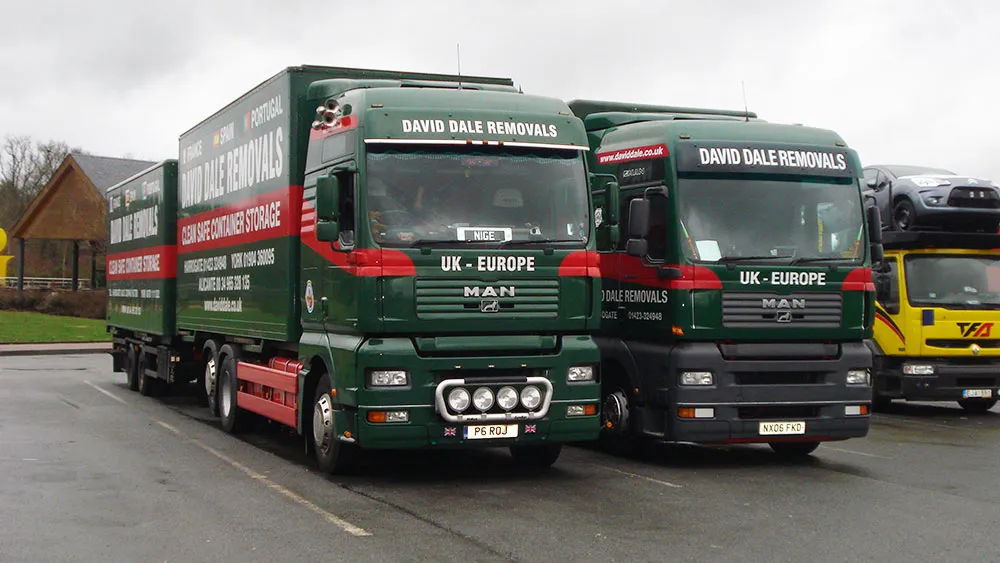
Consolidated loads reduce cost for smaller volumes. If you’re moving the contents of a one or two-bedroom flat, a dedicated vehicle is hard to justify. Road freight operators, David Dale included, run part-loads on regular consolidated services. Your belongings share vehicle space with other customers heading to the same region. You pay for the cubic footage you actually use, not the full lorry.
Direct routing means fewer handling points. Every transfer between vehicles or containers adds a small risk of damage. Road freight from our Knaresborough depot to your Spanish or French address usually involves one transfer point at most. A containerised sea shipment adds several more: loading at your home, depot consolidation, port loading, vessel loading, port discharge, container stripping, and final truck delivery. Each stage is a handling event. Our export wrapping service uses bespoke timber crating and export-grade materials to protect fragile or high-value items at every stage, whichever method you choose.
Customs paperwork stays simpler. Post-Brexit, both road and sea shipments need a transfer of residence declaration to bring household goods into an EU country duty-free. Road freight clears this at the land border crossing. Maritime customs adds the destination port authority and a local customs agent, plus paperwork specific to sea cargo. It’s manageable, but it’s an extra layer.
Scheduling fits a regular route. David Dale runs a weekly UK-Spain-UK service, so your collection and delivery dates are predictable. You book onto the next available run instead of waiting for a vessel departure slot. That wait can add two to three weeks to the lead time on a sea shipment.
When a Shipping Container Might Be Worth Considering
Shipping containers aren’t the standard choice for European removals. Even so, a few situations bring them into the conversation:
- Island destinations. If you’re moving somewhere off mainland Europe, such as Majorca, Ibiza, the Canary Islands, Madeira, or the Azores, a sea leg is unavoidable. Containerised shipping becomes part of the route regardless of preference.
- Very large volumes. A full household with a lot of furniture, specialist equipment, or a vehicle collection may fill a 40ft container. At that volume, a dedicated road vehicle and a container sit closer in capacity, and sea shipping can occasionally work out cheaper on specific port pairs.
- Vintage vehicles or specialist items. Some customers moving classic cars or motorcycles prefer a sealed steel container for the sea crossing. However, David Dale also carries cars and bikes alongside household goods on European road freight runs, so this isn’t always a reason to go sea-only.
Overall, for moves to Spain, France, or Portugal from North Yorkshire or the wider UK, road freight is the better fit in most cases. The weekly service, door-to-door delivery, and consolidated load option make it more flexible, and usually more cost-effective, than a containerised sea route.

Customs: Road vs Sea for European Removals
Post-Brexit customs is the part of a European move that catches people out most. Here’s what changes between road and sea.
Road freight customs
Your coordinator prepares a detailed inventory of everything you’re moving. We then submit the transfer of residence application before the move. At the land border, usually the Channel Tunnel or a ferry crossing into France or Spain, UK paperwork clears on this side. Then the destination country’s customs authority clears the goods at the point of entry. For Spain, that’s typically Irun or La Jonquera. For France, clearance happens at the port or tunnel terminal itself.
Maritime customs
The same transfer of residence relief applies, but clearance happens at the destination port instead. Bilbao, Valencia, and Lisbon each run their own port customs authority and a panel of licensed customs agents. You’ll need to appoint one of these agents at the destination port. Agent fees vary by port and by agent, so ask for a full cost breakdown when you compare road and sea quotes. Port storage fees can also apply if clearance takes longer than the free-storage window, and this window varies by port.
At David Dale, our single-point coordinator handles this paperwork on both methods, wherever we operate the route. For Spain, France, and Portugal, we handle the inventory, the transfer of residence application support, and liaison with customs for you.
A note on transfer of residence relief
Each destination country grants this exemption under its own customs rules, which mirror the shared EU framework. You’ll typically need to show you’ve lived outside the EU for at least 12 months and have owned and used the goods for at least 6 months. Requirements can vary slightly by country. Always confirm the current position with your coordinator or the destination country’s customs authority before you move.
FAQs
For most European routes, road freight on a consolidated service costs less than a shipping container, especially for volumes under 50 cubic metres. A 20ft container has a minimum chargeable volume of roughly 28 cubic metres, and it attracts port handling fees at both ends. Road freight, however, charges by the cubic footage you actually use, with no port fees. For moves to mainland Spain, France, or Portugal, ask for quotes on both and compare the all-in figure, including customs agent costs on the sea option.
Road freight from the UK to Spain typically takes three to seven days from collection to delivery, depending on the departure point and destination. A shipping container on the same route takes fourteen to twenty-eight days once port handling, vessel scheduling, and the final overland leg are included. David Dale runs a weekly UK-Spain-UK service across roughly 50 weeks a year, so the departure schedule stays predictable rather than tied to a vessel’s sailing dates.
Yes. Since January 2021, the UK has treated household goods moving to any EU country, whether by road or sea, as a third-country import. Transfer of residence relief lets you bring used household goods in duty-free and VAT-free, provided you’ve lived outside the EU for at least 12 months and owned and used the goods for at least 6 months. You’ll need to submit the application before the move. David Dale’s coordinator handles this as part of the European removals service.
Yes. Cars and motorcycles can travel alongside your household goods on David Dale’s European road freight service. We quote specialist vehicles separately from the household goods volume. This is often more convenient than arranging a separate vehicle transporter, and it means both elements clear customs under the same transfer of residence declaration where eligible. Contact us for a quote covering both the household goods and the vehicle.
Ready to Compare Quotes for Your European Move?
David Dale has handled European removals since 1976, with our own depot in Almoradi and a weekly UK-Spain-UK service that runs almost year-round. Whether your move suits a consolidated road freight run or a dedicated vehicle, our coordinator will talk you through the options. From there, we’ll give you a fixed-price quote covering collection, packing, customs paperwork, and delivery.
You may also be interested in: Removals to Spain · Removals to France · Removals to Portugal · Export Wrapping Service · Car & Bike Transportation · Online quote