
Customs Rules for Moving Household Goods Between the UK and Europe
Customs rules for moving household goods between the UK and Europe changed after Brexit. Most people only find out how much when a shipment gets held up. If you’re heading to France, Spain, or Portugal, or coming back to the UK after living abroad, your belongings now cross a customs border. Get the paperwork right and your goods clear without a second look. Get it wrong, and they sit in a holding yard while someone sorts out a declaration.
David Dale has run European removals since 1976. We’ve run a weekly UK-Spain-UK service for close to 50 years, and we’re rated 4.9 out of 5 from 110 reviews. So this guide reflects what actually happens on these moves, not just a summary of gov.uk pages.
The Core Change: UK-EU Customs After Brexit
Before the Brexit transition period ended, household goods moved between the UK and EU countries with no customs formalities. That changed. The UK is now a third country as far as the EU customs union goes. The same is true in reverse.
Goods travelling either way need import and export declarations now. That covers someone relocating to Spain for good. It also covers a part-load of furniture going to a French holiday home.
For most private household moves, this doesn’t mean a large tax bill. Transfer of Residence (ToR) relief protects people who are relocating permanently. The UK runs this scheme, and EU countries run their own equivalent. Neither charges duty and VAT on things you already own and use.
Problems tend to come from three places: missed qualifying conditions, late paperwork, or non-qualifying items mixed into the same shipment. New purchases, commercial stock, and vehicles all sit outside the main relief. Each needs separate handling.
Our coordinators prepare your customs inventory and paperwork before the lorry loads. That’s part of the service, not an add-on.

Transfer of Residence Relief: Moving Back to the UK from Europe
Transfer of Residence relief is what lets you bring your household goods into the UK without paying import duty and VAT. HMRC runs the scheme. You need to meet all of these conditions:
- You’ve been resident outside the UK for at least 12 consecutive months before the move.
- You’re importing the goods within 12 months of coming back to live in the UK.
- You’ve owned and used the goods for at least 6 months before the move.
- You intend to use the goods in the UK for the same purpose they served before.
- You won’t lend, sell, hire out, or use the goods as security for 12 months after import.
HMRC must approve your relief before it applies. If a removal company is shipping your goods, you’ll need to complete a ToR1 form first and get a unique reference number before the shipment leaves. Your removal company then uses that reference on the import declaration. If you’re carrying items with you instead of shipping them, you’ll usually declare them by conduct or with an oral declaration at the border.
Some goods won’t qualify. That includes new or unused items, things bought specifically for the move, anything still in its packaging, or goods without a genuine period of use abroad. You’ll pay standard import duty and VAT on these. Declare them separately from your qualifying goods. Mixing them into the same shipment can hold up clearance for everything.
Vehicles follow their own rules. You’ll need a separate Notification of Vehicle Arrival (NOVA) declaration alongside your household goods claim. Flag any car or motorbike at survey stage so we keep the paperwork separate.
| Condition | ToR relief applies | ToR relief does not apply |
|---|---|---|
| Owned and used abroad for 6+ months | Yes | No, if bought new for the move |
| Resident abroad for 12+ consecutive months | Yes | No, if abroad for less than 12 months |
| Imported within 12 months of returning to the UK | Yes | No, if brought in after the 12-month window |
| Personal effects and household goods | Yes | No, for commercial goods or stock |
| Vehicles | Needs a separate NOVA declaration | Cannot be included in the household goods claim |
Moving to France, Spain, or Portugal: EU-Side Customs Rules
Moving from the UK to an EU country works the same way in reverse. Each country runs its own version of the EU customs code. The qualifying conditions follow a similar pattern to the UK’s ToR relief:
- You’ve been resident in the UK for at least 12 consecutive months before the move.
- You’ve owned and used the goods in the UK for at least 6 months.
- You’re moving to take up normal residence in the destination country.
- You (or your removal company) lodge the application with the national customs authority before or at the point of import, in most EU states.
Spain’s customs authority is the Agencia Tributaria. France’s is the Direction Générale des Douanes et Droits Indirects. Portugal’s is the Autoridade Tributária e Aduaneira. The paperwork format, proof-of-residence requirements, and application forms differ slightly between countries. Our coordinators have handled these declarations for moves into southern Spain for decades. That country-specific knowledge often makes the difference between a clean clearance and an avoidable delay.
One practical point on timing: some regional customs authorities process applications faster when you submit well ahead of the lorry’s arrival. Book four to six weeks before collection for most moves. That also leaves time to sort out any documentation queries before we load the vehicle.
Our European removals team can walk you through timings and costs for your route.
What the Customs Inventory Covers
The customs inventory describes your goods to the customs authority. It isn’t a loading list for the removal crew. It’s a legal declaration, so getting it right matters.
A properly prepared inventory for a European household move includes:
- A full list of items being moved, described in plain terms (not just “boxes”: contents matter)
- Approximate second-hand values for the goods, not replacement value
- Confirmation that you’ve owned and used items for the required period
- Any non-qualifying goods listed separately (new items, restricted goods)
- Vehicle details on a separate schedule, if a car or motorbike is travelling
- Proof-of-residence documents covering the qualifying period
Our coordinators go through the inventory with you before the move date. Gaps or inconsistencies cause most clearance delays on European moves. Good preparation at survey stage avoids this entirely.
Export Wrapping and Packing for European Moves
Customs clearance is one side of a European move. Getting your goods safely across a 1,000 to 2,000 kilometre road transit and a Channel crossing is the other.
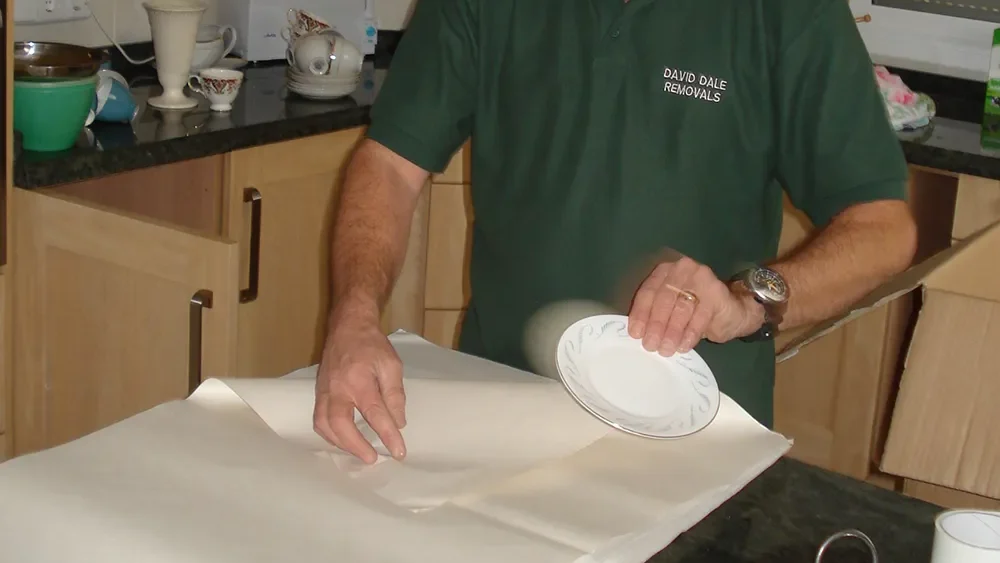
We use export-grade packing materials for European moves. That means double-walled boxes, barrier foil, bubble blankets, and bespoke timber crating for antiques, stone tops, mirrors, and oversized pieces. Our export wrapping service covers fragile and high-value items that need protection beyond standard domestic packing.
Export wrapping isn’t the same as packing for a local move. These materials handle longer transit distances, humidity and temperature changes, and the mechanical stress of a lorry crossing the Channel. If you’re moving antiques, artwork, or specialist furniture from a French property or a Spanish villa, the packing specification matters as much as the customs paperwork.
How David Dale Handles the Customs Process
A single coordinator handles every European move we run, from survey to delivery. We’re a BAR member (D040) and we’ve run the UK-Spain-UK lane for close to 50 years. We don’t outsource customs paperwork to a broker. Our own team prepares the inventory, submits the declarations, and deals with UK or EU customs authorities directly.
In practice, that looks like:
- Survey. We confirm volume in person or by video, flag any goods outside relief scope, and start the documentation checklist.
- Inventory preparation. Your coordinator goes through the goods list with you, confirming values, ownership periods, and anything needing separate declaration.
- Declaration submission. We submit the ToR application, or EU equivalent, to the relevant authority before the collection date.
- Collection and packing. We wrap your goods to export specification, load, and seal them.
- Transit. Your goods travel on our scheduled UK-Spain-UK service, running roughly 50 weeks of the year, or on a dedicated vehicle for full house moves.
- Clearance and delivery. Your coordinator tracks clearance status and confirms a delivery window once your goods are through.
We don’t just follow a sat-nav; we know the route, the authorities, and the paperwork on both sides. That’s what close to 50 years on the European lanes looks like in practice.
Want the full picture on routes, timelines, and pricing? Our European removals page covers all three, and our international removals page covers moves further afield.
FAQs
Not if you qualify for Transfer of Residence relief. This lets UK residents returning from abroad import owned and used household goods free of import duty and VAT. You’ll need to meet three conditions: 12 months of continuous residence outside the UK, ownership and use of the goods for at least 6 months, and importing within 12 months of returning. New or unused goods in the shipment don’t qualify, so declare these separately. Our coordinators review your inventory before the lorry loads to confirm what qualifies.
Book four to six weeks before your intended collection date for most European moves. That gives you time to complete the customs inventory, submit the ToR application (or EU equivalent) before the lorry arrives, and resolve any documentation queries before collection. Book eight weeks ahead for a full house move, or one involving vehicles, antiques, or high-value items needing specialist crating. Leaving the paperwork until the week before collection causes most avoidable delays.
New or recently purchased goods don’t qualify for Transfer of Residence relief. This includes anything still in original packaging, bought specifically for the move, or without a genuine period of use abroad. You’ll pay standard import duty and VAT on these. Declare them separately from your qualifying household goods rather than folding them into the ToR application. Mixing qualifying and non-qualifying goods in one declaration can delay clearance for the entire shipment. Flag any new purchases at survey stage and your coordinator will advise on the split.
Generally not, if the move doesn’t involve UK residency or a UK delivery address. The post-Brexit rules apply specifically at the UK-EU border. Say your goods transit through the UK via Dover without being unloaded or retained. A transit procedure usually covers this, rather than a full import or export declaration. Moves involving a UK leg, such as storage in the UK or delivery to a UK address before onward movement, get more complex. Raise this at survey stage if your move involves more than one country.
Ready to Discuss Your European Move?
We’re a BAR member (D040) with close to 50 years moving households between North Yorkshire and France, Spain, and Portugal. One coordinator handles your move start to finish, on a fixed-price quote that includes the customs paperwork.
You may also be interested in: European removals · Removals to Spain · Removals to France · Export wrapping service · International removals · Online quote